It goes without saying that Beijing, a city of 22 million as of 2024, is a crowded place. While city planners have dealt with this by encouraging people to move well outside the city’s center and into massive high-rise apartments, one architect has proposed a more radical approach as a means for more people to stay in place.
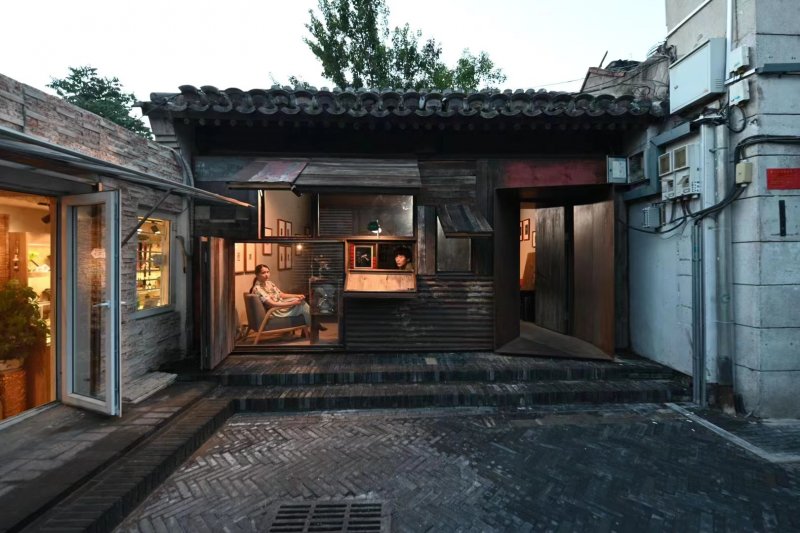
Designed by architect Zhang Ke and his studio standardarchitecture in 2013, “Micro Hutong” is an architectural experiment hiding behind what looks to be an unassuming wall of wood and corrugated steel. Through the rusted metal entryway and massive wooden door, though, and the space becomes filled with light.

Not unlike Beijing’s courtyard houses of old – yards with four roomed areas centered around a courtyard and mostly hidden behind walls of stone – Micro Hutong offers an “alternative to hutong preservation and actualization,” writes ArchDaily.
Within the space, a semi-enclosed sitting area peers into the main living area. Instead of being filled with divided and cramped micro apartments like most of today’s courtyard houses, rooms are instead divided into small pods with large windows.

The result is a space in which people can live and interact together, with the wood and steel paneling on the outer street-facing wall able to open to allow light in. What results, according to ArchDaily, is a space meant not just for its occupants but the surrounding community as well.
What’s more, all of this is accomplished with less space at 30 sqm and low-cost building materials like steel and wood.

Today, the building itself is a semi-public space, opening to allow architectural students for study, and to host small exhibitions and concerts.
Address:
53 Yangmeizhu Byway, Xicheng District, Beijing
北京市西城区杨梅竹斜街53号
Images: courtesy of Felix Li

 Offbeat Angles_
Leave a comment